In my search for relation between the digital and analogue image I have decided to embark upon a quest for real materials and to try and understand why I paint. When I'm preparing my canvas I feel as though I'm making some kind of relationship with it. A surface is created specific to my own intentions and judgements and becomes mine with care but paint has always been a substance I have a rough knowledge of. Like a lot of painters, when I paint the origin of materials becomes much less importantthan their physical properties.
So far I have discovered that making paint (as I had imagined before attempting this course of action) is a long and arduous process involving toil. Lots and lots of toil.
Reading What painting is by James Elkins with its comparison of the painter to the alchemist also makes me feel more confident about my trailer park style paint making "lab" on top of my freezer. Although my neighbors probably think I'm trying to re-create Tom Waits Whats he building in there?
The tools (mortar and pestle, hammer and chisel, marble slab and paint muller) and rocksI used
My process starts by going out with a hammer and chisel collecting soft looking rocks from the local area. I'm not sure of the specific rocks I collected but they were soft sedimentary rocks from the South Wales region and most likely to be old red sandstone.
I take the collected pieces of rock and split them again and try to get rid of large areas of impurities in the rock. Then I crush the little pieces with some water (to control dust) in a large mortar and pestle.
crushing of rocks
I had to include steps to refine the pigment material after impatiently and foolishly thinking that the rock dust particles would be fine enough to grind into paint. They weren't. What I got was paint with sand in it which looked like shit. Literally as you can see here:
First attempt at paint, probably useful for painting pictures of poo and not a lot else
So I had to start filtering the dust like so:
I pour water over the dust in the mortar and let the heavier sediment fall to the bottom. It takes about 20 minutes to filter out the grains that are too large.
mixed sediment and water
Then I carefully pour the water off out into a plastic container making sure not to let bigger grains fall in.
I leave this container on a window sill in the sun to evaporate the water and leave the fine sediment behind. This takes a while when you live in Wales not Venice. If Titian needed to dry out some pigment I'm going to assume it would only take a day or two in the Italian sun.
small amount of fine sediment suspended in water
Dried pigment dust
After the water evaporated I took the layer of dust in the bottom of the container and scraped it onto a marble slab ready to combine with a binder which in this case was cold pressed linseed oil. I used a glass paint muller to combine the pigment and binder. During the mulling the smooth surfaces of the glass and the marble coat the pigment particles in oil. It takes a little while.
The final successful paint (about 2ml)
Of course the whole process needs to be repeated as the amount of material from each batch of crushing and filtering is quite small. The method is by no means precise and the only colours I've managed to produce are varying shades of brown and grey. The amount of labor involved in making the tiniest amount of workable paint is amazing. The process was very meditative and calming and the hours of crushing rocks gave me time to reflect on my ideas for paintings.
I'm going to continue making pigment with this process and experiment with different binders and possibly branch out into making grounds for canvas.
Picture of the triptych The Last Judgment installed in Tate Britain
Just went to see the John Martin show at the Tate. I'd been waiting a while to see it and I was lucky I didn't miss it as it closed today.
I have mixed feelings about the exhibition. I love John Martin's work, I always have but the show really aggravated me.
First of all before I even got into the show I was reading the little hand out books they give you while I waited in the queue. Seven of the pages (and there were only 10) just gave examples of modern day productions which were inspired by Martin's work. I mean yes its interesting to hear about how people have taken inspiration but usually that kind of information takes a backseat to stuff about the artist and their life. Already before even seeing the displays I felt like I was being patronized. The whole exhibition seemed designed to make people more interested in art they might not necessarily appreciate but in completely the wrong manner.
Personally I feel that it is essential that any exhibition attempt to promote itself to a wider range of people and not just to people who are already interested in art. However this was just embarrassing.Getting people interested in art shouldn't be a case of changing art to please people. The cherry on the processed culture cake was the projection show of Martin's triptych The Last Judgment , which is considered his most sublime and moving work. It was, quite frankly, pathetic and so condescending I can hardly even bring myself to think about it again. It sounds hypocritical of me, as I'm currently experimenting with projections over traditional painting, but this was crass and infantile. Visitors sat in a darkened gallery space while lights and even worse moving animations are projected over the paintings and voices with both English and American accents narrate the paintings for you, in case you know you can't actually look at what is in front of you quietly. It was very crowded I sat on the floor so it felt even more like story time in junior school.
I remember the first time I saw final painting in his triptych The Last Judgment. It was always in Tate Britain displayed in their permanent collection. I remember seeing it and being transfixed and I sat down to make charcoal studies of it and it wasn't receiving half the amount of attention I saw it get yesterday.
I just despair for a world where not only have people lost the patience to paint such sublime images, but have lost the patience to even look at them without a big animated light show and a voice to guide you through so you won't have to spend all that effort thinking for yourself about anything.
It wasn't all bad though. There were so many beautiful mezzotint prints on display that were just breathtaking. Another gem was a tiny illustration of iguana-don in a prehistoric landscape that sat on a page of an archaic geology manual. I suppose all in all I'm glad that John Martin is getting more appreciation than he used to and that people will recognize his existence its just that its a hollow ghost of an applause unfortunately.
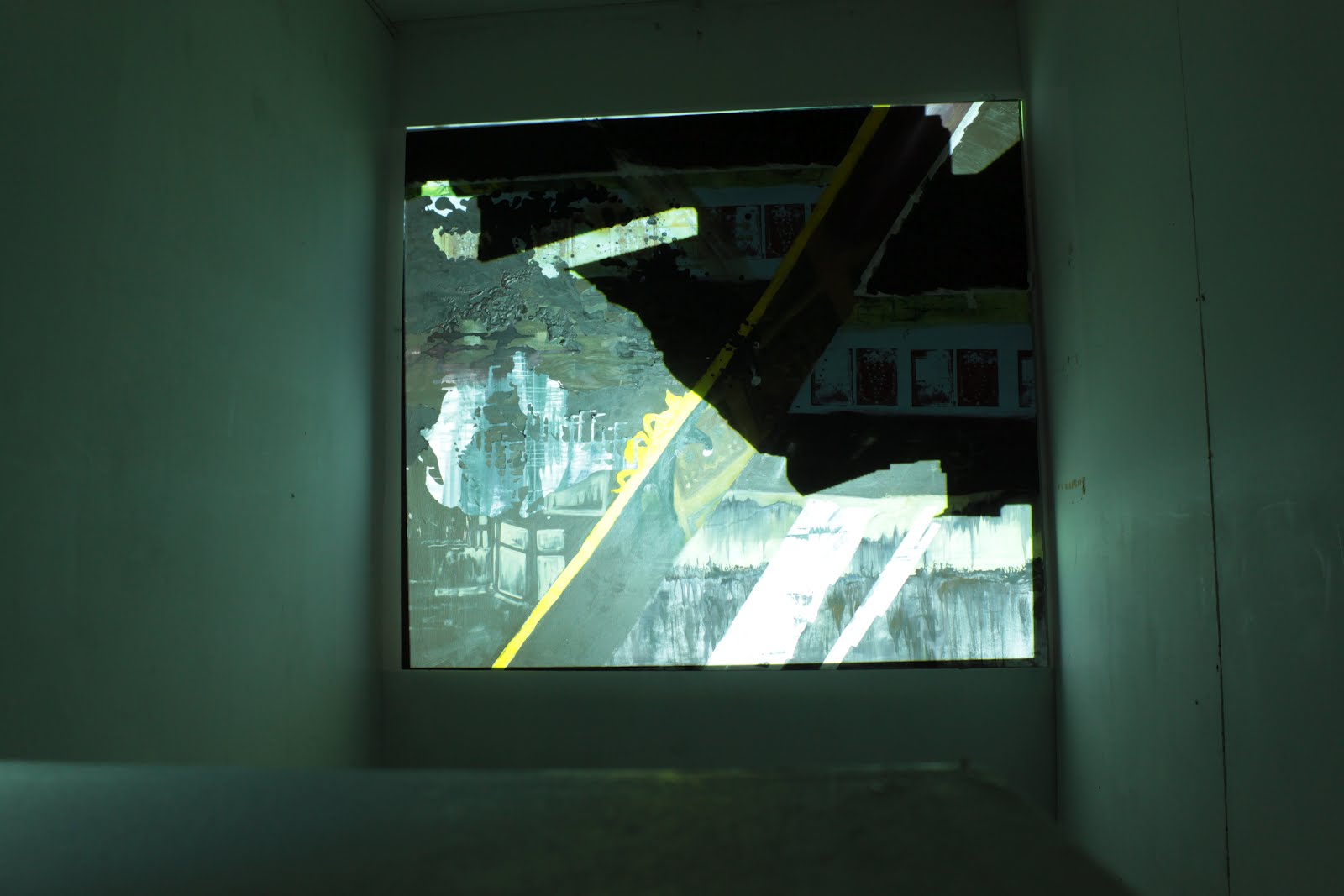
I hung some paintings I have been working on recently in a secluded space away from my studio clutter. Mostly this was to see how they hang together. The space was small and cosy but lacked sufficient lighting that is needed to display paintings properly. Then I started thinking more about the "proper" ways to hang and light paintings. Paintings in National museums are often lit very specifically from different angles with varying diffusion in order to highlight certain parts of an image. In a way this means that the lighting is a secondary layer to the painting, akin to glazing in some way.
I had the idea to attach fairy lights onto my paintings, simply because I wanted to see what would happen. The effect of the lights in localized areas of the paintings worked well they added a new depth and reality. However as whole objects they were very scrappy with references to christmas that were just a bit too blatant.


 The tools (mortar and pestle, hammer and chisel, marble slab and paint muller) and rocks I used